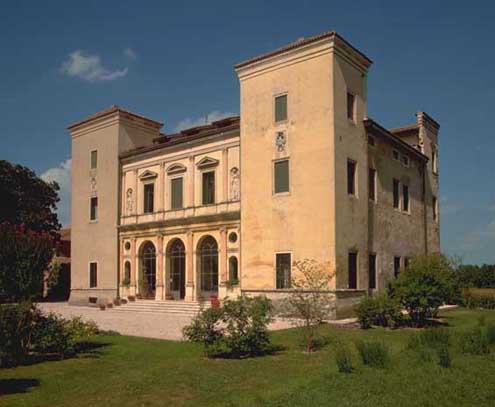
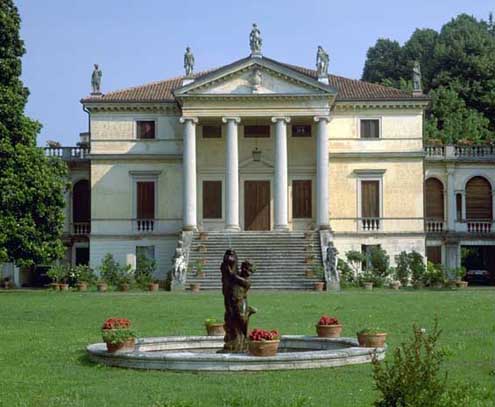
Vicenza is known as ‘Palladio’s town’ as he realized several monuments here and it is one of the most relevant art sites not only in the Veneto. Just thanks to the works by the great architect, the Unesco has included Vicenza in the list of the World Mankind’s Heritage and, as a matter of fact, it is the destination of cultural tourism with flows of people coming from all over Italy and from abroad too.
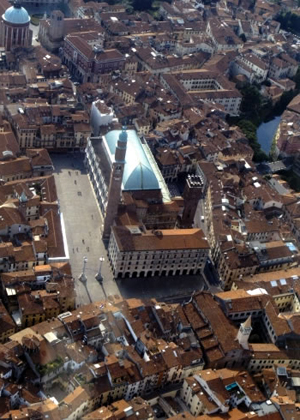 HISTORY
Already known as ancient Vicetia during the Roman Age, the most ancient match about its name dates back to 135 B.C.
The epoch of the communes then witnessed the infighting between the Guelfs and the Ghibellines, with alternating outcomes, until Vicenza was conquered in 1311 by the Veronese Scaligeri rulers. This family rebuilt the city walls around a greater area as a protection against the invasion of the Visconti family, who, nonetheless, finally prevailed in the conquest of the town and they continued to rule the city until 1404. From 1404 to 1797 Vicenza put itself spontaneously under the protection of the Republic of Venice (as other towns of the Veneto and the Lombardia did) and it became part of the Serenissima Republic of the Veneto.
During the four centuries which followed, characterized by peace and wealth, arts reached exceptional levels and the town economy flourished.
The Sixteenth century is related to the great late Renaissance architect Andrea Palladio, already previously mentioned, who bequeathed Vicenza and the whole world a unique architectural heritage. Among his main works, the Basilica Palladiana situated in the central Piazza dei Signori, the Olympic Theatre, Villa Capra, known as ‘The Rotonda’, placed just outside the urban area. The Palladian tradition was continued by Vincenzo Scamozzi and by other architects till the Eighteenth century.
In the Nineteenth century, after Napoleon’s fall, the town fell under Austrian dominion and later became part of the Kingdom of Lombardy-Venetia and it was annexed to the Kingdom of Italy in 1866. If during the First World War battles mostly took place just the province of Vicenza, the Second World War injured the town centre too, as it was severely damaged by the Allies’ air raids.
MONUMENTS
The Basilica Palladiana, rebuilt in 1614 by Palladio is a public building opening onto Piazza dei Signori, which represented the core of not only political activities (citizen Town Council, Court) but also economic ones.
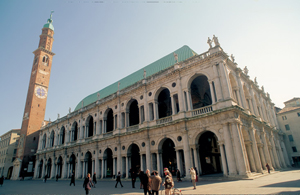 The double order of white, Piovene stone loggias offers elegance and solemnity: the ascent of the structure seems infinite, the tricks of light and shade are captivating. The first nucleus of the building known as the Palazzo della Ragione was constructed in the middle of the 15th century by joining two older buildings: the “Palatium Vetus” and the “Palatium Communis”. Then, at the end of the 15th century, it was decided to give this building a new aspect and create covered spaces for the markets that were held around it. The ambitious capsized keel-shaped covering made of copper plates, partly raised by large arches, dates back to the half of the Fifteenth century. The loggias which were to surround the building were planned by the architect, Tommaso Formenton. These were duly built and gave the palace a similar appearance to the one of the same name in Padua. But faulty construction led to their collapse only two years after completion, presenting the problem of rebuilding. Though many great artists were consulted, from
 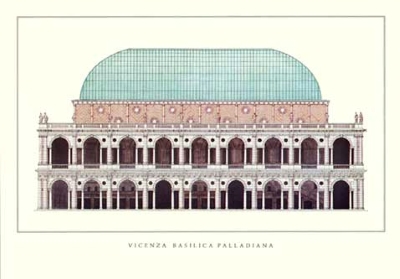 Sebastiano Serlio to Michele Sanmicheli and Giulio Romano, a solution was not quickly found – fifty years were to pass before the plans drawn up by Andrea della Gondola, later known as Palladio, were chosen. Built in a Gothic style, Palladio by his verging on classic style loggias solved the hard static problems and by his use of serlian windows he adopted an ingenious expedient in order to conceal the different distances between pillars inherited by previous work.
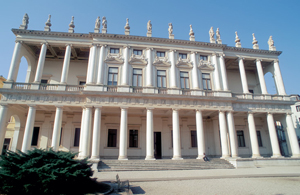
PALAZZO CHIERICATI
Its construction was started in 1557 and it was ended in 1680 by Palladio. It was a private residence composed by a central body with two slightly behindhand symmetrical bays, endowed with two great loggias on the ‘noble floor’. The harmonious façade has got two superposed orders, which is a solution never used before for a town private residence, and decorated with statues. Located where in past times the rivers Bacchiglione and Retrone met, the architect placed the palace on an elevated position to protect it from frequent floods. From the half of 1500 to the first half of 1600 Chiericati Palace remained a majestic fragment (similar to the present Porto Palace in Castello Square) but half-finished at the fourth bay, just as proved by the Pianta Angelica and the note-books of travellers.
Only at the end of the Seventeenth century the palace was finished according to the rules of Palladio’s Four Books. There are different Palladian autographs testifying the developing of the plan, from an early solution where the portico juts out just in the middle of the façade (besides it is covered with a tympanum, as it will be for Villa Cornaro) till the current one. Its plant is determined by the narrow dimensions of the site: a central entrance with two apses next to two nuclei of three rooms having harmoniously joint together dimensions, each of them with a service spiral staircase and a monumental one next to the back loggia (another element which will be present in Pisani and Cornaro villas). In order to supply the building with magnificence, but also to protect it from frequent floods (and from the cattle which used to be sold in front of the palace during market days), Palladio placed it on a raised platform which, in the middle, displays a wide staircase clearly inherited by an ancient temple. The extraordinary novelty represented by Chiericati Palace among the existing Renaissance urban residences owes so much the Palladio’s ability to interpret the place where it was built; a wide open space on the borders of the town, near a river, that is a context giving the building an ambiguous look, namely a palace and a suburban villa at the same time: it is no coincidence that there are a lot of affinities with Villa Cornaro in Piombino and Villa Pisani in Montagnana.
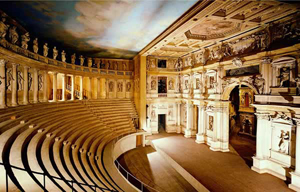
Olympic Academy
Founded in 1556, the Olympic Academy had to wait more than twenty years before succeeding in realizing a permanent theatre where performances could be held, as in the past they were staged on ephemeral wooden structures in the palaces courtyards or in the hall of the Palazzo della Ragione. Only in 1580, in fact, the Academy starts, on an area of the Isola, handed over by Vicenza town hall, the construction work of the theatre according to the plan of its academic Andrea Palladio. But in the August of the same year the architect died without seeing the end of the construction, carried out by his son Silla. After Palladio Vincenzo Scamozzi was entrusted with the development of the theatre and he added the stage as well as the scenery, which was set up for the inaugural performance in 1585 of the Sette Vie di Tebe, which was to become an integral part of the building. Some recent studies have shown that the original Palladian plan envisaged just one perspective developed in connection with the central entrance of the stage, whereas on the two side openings some painted backgrounds would have had to be placed.
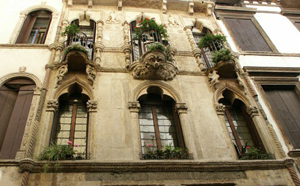
PIGAFETTA’S HOUSE
It was restored till it put on its present look in 1440. Inhabited by Antonio Pigafetta and modified in 1481, it is a rare example of florid Gothic, having queer decorative partitions, based on twisting subjects. The arabesque style side entrances have got three arches. The Renaissance portal is next to a writing hinting at the coat of arms of Pigafetta’s family.
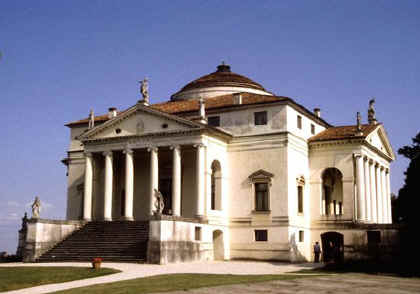
THE ROTONDA
On one of the hills surrounding Vicenza, you can see Villa Almerico Capra di Valmarana, known as the Rotonda. It is the most famous and imitated work realized by Andrea Palladio, whose artistic originality is slowly unveiled to the amazed eye of spectators in front of four perfectly identical facades. Villa Capra, known as the Rotonda, was ended in 1585 by Andrea Palladio and it is a villa with a central plant, built as a suburban residence for entertainment functions, but also as a quiet shelter for meditation and study. It is composed of a square building which is completely symmetric and which can be inscribed in a perfect circle. Each of the four facades was endowed with a forepart having a portico from where people got to the domed central hall. Also the decorations are enriched with formal elements which were to suggest a sacred meaning. Located on the roundish top of a small hill, in order to let every room get an equal sunlight, its plant was rounded for 45 degrees with respect to the cardinal points.
LEONI MONTANARI PALACE
Finished in 1678, it is a baroque residence built where the Leoni Montanari family already owned some buildings, including some rooms for the spinning of silk. The palace is decorated with some episodes of Greek and Roman mythology. In the Eighteenth century the building was modified according to a neo-classical style. It has got a remarkable picture gallery displaying some masterpieces of the art of the Veneto region as well as a collection of Russian icons.
THE MUSEUMS
MONTANARI PALACE GALLERY
It is a museum owned by Banca Intesa. The gallery is permanently located in the baroque residence of the Leoni Montanari family and supplies the public with two of the most relevant art collections in the Institute. On the noble floor, next to the hall for performances and concerts, the architectonic visiting path of the Eighteenth century rooms displaying exuberant decorations based on mythological subjects, has arranged a precious painting collection from the Veneto Region of the Eighteenth century, among which a remarkable corpus of paintings by Pietro Longhi, some urban views and architectonic ‘capricci’ by Canaletto, Luca Carlevarijs, Francesco Guardi.
On the upper floor of the palace, plunged in a rarefied and bated spiritual atmosphere, a careful selection of 130 Russian icons is displayed. They have been chosen among over four hundred paintings belonging to the collection owned by Banca Intesa. Such collection is regarded by critics as one of the most important in the West for its narrative themes, its chronological variety going from the thirteenth to the fourteenth centuries as well as for the presence of several masterpieces of other historical periods. Thanks to the wide range of regional schools which are there testified, besides works deriving from major cities such as Mosca, Novgorod, Vladimir, Tver’ and Pskov, this collection represents the various souls of Russian painting.
CIVIC MUSEUM
The museum is arranged inside Chiericati Palace, namely a marvelous building planned by Palladio for Girolamo Chiericati in 1551. the visiting path follows chronological standards and begins with a section devoted to sculpture and painting of 1300, where a polyptych by Paolo Veneziano stands out; then there is a section of 1400 with works by local artists and works from the school of Verona and Lombardia; the Sixteenth century is represented by some masterpieces by Paolo Veronese, Jacopo Tintoretto, Lorenzo Lotto and Jacopo da Bassano; the Seventeenth century includes some works by local artists such as Francesco Maffei and Giulio Carpioni, as well as ‘The ages of man’, that is a wonderful painting by Van Dyck and the ‘Madonna of velvets’ by Bruegel; the Eighteenth century preserves some paintings by Giambattista Piazzetta, Giambattista and Giandomenico Tiepolo, Rosa da Tivoli and many others.
In the end, in the northern aisle of the palace there is a contemporary art collection with works by Carrà, De Pisis, Guidi, Oppi, Tancredi and others. You cannot miss four maps of the world of the Seventeenth century, endowed with their original supports.
RISORGIMENTO and RESISTENZA MUSEUM – Historical Museum
SANTUARY OF MONTE BERICO MUSEUM – Art Museum
NATURE MUSEUM OF SANTA CORONA
SMALL MUSEUM OF COINS
HOW TO ARRIVE
BY PLANE
There are airports nearby, in Venice (60km) and Verona-Villafranca (60 km), Mialno –Linate (200 Km), Milano – Malpensa (260 Km).
a (Verona’s Valerio Catullo Airport).From these airports it is BY Vicenza has its own airport (Tommaso Dal Molin), which is currently operating for military purposes as well as for night and day civilian and trading routes. It deals with scheduled flights, executive, private, transport of valuables and goods, health, assistance and civil defence flights.
BY CAR
Vicenza is a hour away from Milan, one and a half hours from Bologna and 30 minutes from Venice and Verona.
There are three motorway junctions: two on the A4 Serenissima Brescia-Padua motorway (Vicenza East and Vicenza West) on the major route from Turin to Trieste.
The third one (Vicenza North) is the A31 Valdastico motorway exit, which connects Vicenza to the A4 motorway and to its province, in particular the North-Eastern areas such as Thiene, Schio, Asiago, Marostica,Bassano.